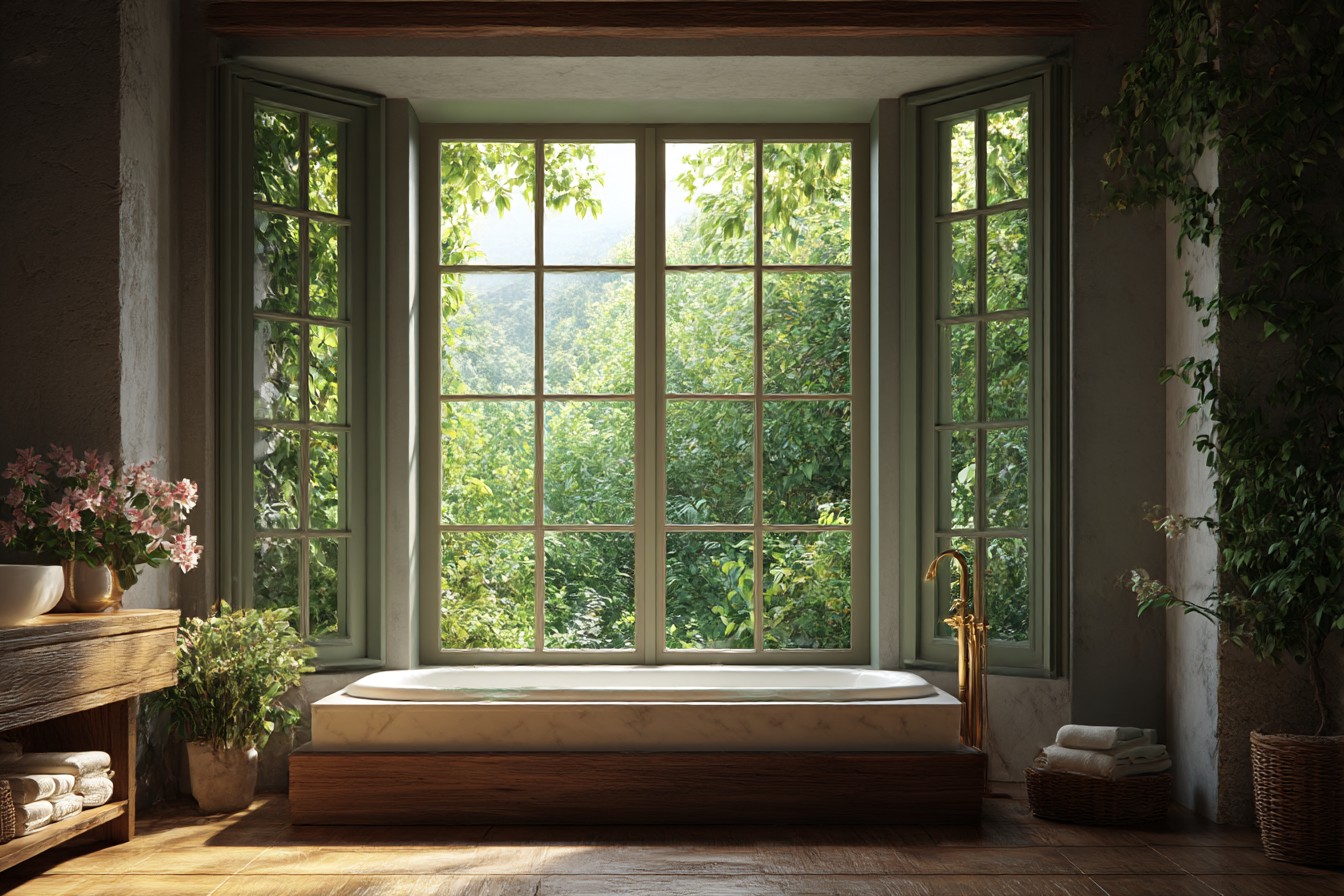
Your neighbors may be able to see right into your bathroom, unless you take some care. That’s what happened to me. After living in a Victorian terrace for roughly 90 days, I was standing in my towel and saw Mr. Henderson from next door stretching in his garden. He saw me and we exchanged a few awkward glances. I quickly ran and hid behind a wall.
At that point I went on a mission to find the ultimate bathroom window solution. Something that would allow me to have the privacy I needed while also letting natural light in the room. Natural light in bathrooms is important for a number of reasons. First, it allows you to see what you’re doing when applying make-up. And secondly, people don’t look their best under bright lights.
First, I tried the obvious answer. I purchased a set of frosted films to apply directly to my window. These were very inexpensive (about $25 per pack) and easy to use. However, the instructions failed to mention anything about eliminating air bubbles. The first time I applied the film, I ended up looking as though I had covered my window in cling wrap after a toddler got excited and stuck her hands and fingers into the film. Bubbles everywhere. I removed the film and tried again. The same problem occurred.
As a result, I watched YouTube videos for a couple weeks until I finally figured out the correct method for installing the films. The key was to mix dish soap and water in a spray bottle and spray both sides of the film. Then use a squeegee to remove the bubbles. By the third time I attempted to install the film, I finally achieved success. From inside the bathroom, the film looked okay. But from the outside it looked as though I had placed contact lenses on my windows. Functionality won out over style at that point.
It worked for about 8 months. Eventually, I grew tired of its utilitarian appearance. Additionally, the film began to peel at the edges due to the high temperatures generated by my hot showers.
Time for plan B. Window blinds were my next choice. I spent hours researching different types of blinds. I considered traditional wood blinds, faux wood blinds, aluminum blinds, and fabric blinds. The representative at the window blind store was helpful, but she obviously didn’t understand my concerns regarding moisture and warping. “You will be fine,” she said. She was wrong.
My initial choice was traditional wood blinds. They were the priciest option ($350 for four windows). I thought they looked expensive and that they would add an upscale feel to my bathroom. Unfortunately, the wood blinds warped in six months. They didn’t warp significantly, but enough so that they would not close properly and had a small bow in them that I noticed each morning. In essence, I wasted $350.
For my second choice, I selected aluminum blinds. I selected these primarily because of their price. The aluminum blinds have lasted for two years without warping. However, they are noisy. Each time you move the slats to block out sunlight, they rattle loudly. This is tolerable during the day, but at night, when you are attempting to crack open a window to let in a breeze without disturbing your partner… it is unacceptable.
In addition to my continued use of the aluminum blinds, I experimented with additional window covering options. I had previously seen shutters, specifically hinged shutters that fold back onto the wall when opened, in photos of beautiful bathrooms on Instagram. I believed they would be the perfect solution. I would be able to maintain my privacy when the shutters were closed and would have unobstructed access to the window when the shutters were open. They would also add an upscale aesthetic to my bathroom.
The estimate for purchasing shutters for one window nearly caused me to experience a heart attack. The estimate was for $900. Yes, you read that correctly. $900. For shutter covers. I realize that they were attractive high-quality wood, custom fit, professional installed but that is the equivalent of a month’s mortgage payment for window treatments.
After some research, I discovered a local salvage yard that sold old shutters that had been salvaged from a home renovation. The shutters were priced at $130 for the pair. They required some work sanding, new hinges, painting but they were solid. I spent the weekend using paint remover and wood stain, and I was actually quite proud of the results.
The shutters performed wonderfully for about a year. They were stunning, allowed for excellent privacy control, and when folded back against the wall, you simply forgot that they existed. Then the lower hinge on the left panel of the shutters began to loosen. Regardless of how many times I tightened the screws, the screws always backed out. I later determined that the deterioration of the wood surrounding the original screw holes was the cause.
This is when I learned that window film had advanced greatly since my first disaster. It wasn’t limited to just the plain frosted film; they now offered decorative options. There are etched glass effect films, geometric pattern films, and even films that mimic stained glass. I located an Art Deco design film that matched the era-specific characteristics of my home.
The application technique that I developed through my previous experiences proved successful. On the first try, I successfully applied the film. No bubbles, no wrinkles, properly sealed edges. The film cost approximately $50 along with the application equipment.
However, I wish I had known something prior to this experience. You don’t have to cover the whole window. I only covered the bottom two thirds of the window. Maximum light enters the room through the top section. Pure genius, if I do say so myself.
When I began to combine different solutions rather than think of it as one-or-the-other, that’s when the true magic happened. The decorative film on the bottom two thirds of the window, combined with a simple white roller shade that I only pull down when I require total darkness such as when I’m taking a long bath and don’t want even shadows visible from the exterior has functioned flawlessly for 18 months.
The roller shade cost $37 from a discount store. Since the decorative film provides sufficient daylight and visual obscuration during normal usage, I was able to select a lightweight and translucent fabric for the roller shade that still allows ample daylight to enter the room.